Two copies of the truth are one too many

I’ve spent the past year talking to software teams about their docs, trying to understand why documentation debt is so universal, and every company tells me the same story.
We actually care a lot about docs. But we have two copies of the same doc, so every update has to happen twice.
Developers update Markdown in GitHub to match code changes, while product teams and writers polish a readable version in a collaborative editor. Both parties get an ergonomic tool built for their language and needs. The problem is that their changes stay there. The moment work splits across two platforms, you lose your single source of truth and both copies drift by default.
You follow the instructions, do everything right, and still pass along a broken workflow because the doc was out of date.
The documentation split-brain
A single doc often needs both an engineering review and an editorial review. Technical teams need to verify commands and code examples, while cross-functional teams need to clarify explanations, leave comments, and suggest changes. The document is shared, but the workflows are completely different.
Forcing documentation into a single environment creates a compromise that serves neither group well:
- Docs-as-code only: Technical teams stay in their flow, but cross-functional colleagues face steep Git friction. Fixing a typo requires branch management and code diffs. Direct edits stop, tickets pile up, and a one-line copy edit becomes an engineering dependency.
- Docs in a wiki only: Cross-functional teams collaborate easily, but technical teams rarely leave their IDE to update a browser tab. As code evolves, documentation silently falls behind until someone trips on outdated instructions.
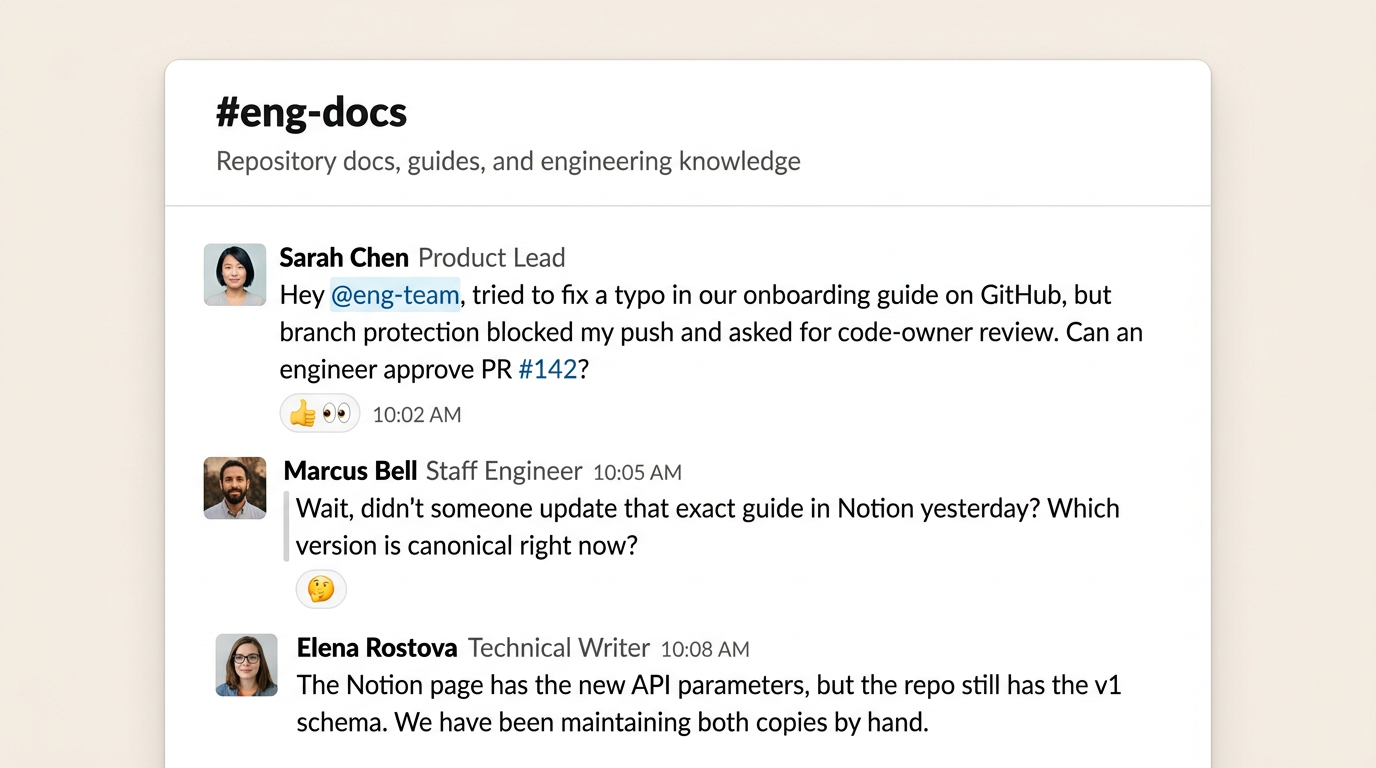
Because no single platform supports both needs, teams accept the burden of maintaining two parallel copies, with Markdown in the repository and an editor workspace that mirrors it. This creates a split-brain problem: teams trust neither copy and spend their time reconciling differences instead of writing new docs.
We built two-way sync so teams can maintain one shared document, whether they edit Markdown in GitHub or use the collaborative editor in Falconer. Changes flow between them without anyone maintaining a second copy.
Bridging Git and the collaborative editor
Making two-way sync work meant keeping documents aligned while preserving how each team writes and reviews them. For both teams to adopt it, we had to preserve the ergonomics of the tools they already used. Technical teams still need IDEs, pull requests, and linters. Cross-functional teams still need rich formatting, real-time collaboration, and suggestion workflows.
The core technical challenge is that Git and collaborative editors represent document state in completely different ways:
- Git is retrospective: It only cares about finished snapshots. To Git, a document is just a plain text file. It is completely blind to in-progress drafting or who is currently working on a page.
- A collaborative editor is live: It coordinates simultaneous typing as it happens, preserving cursor presence, inline suggestions, and active review threads.
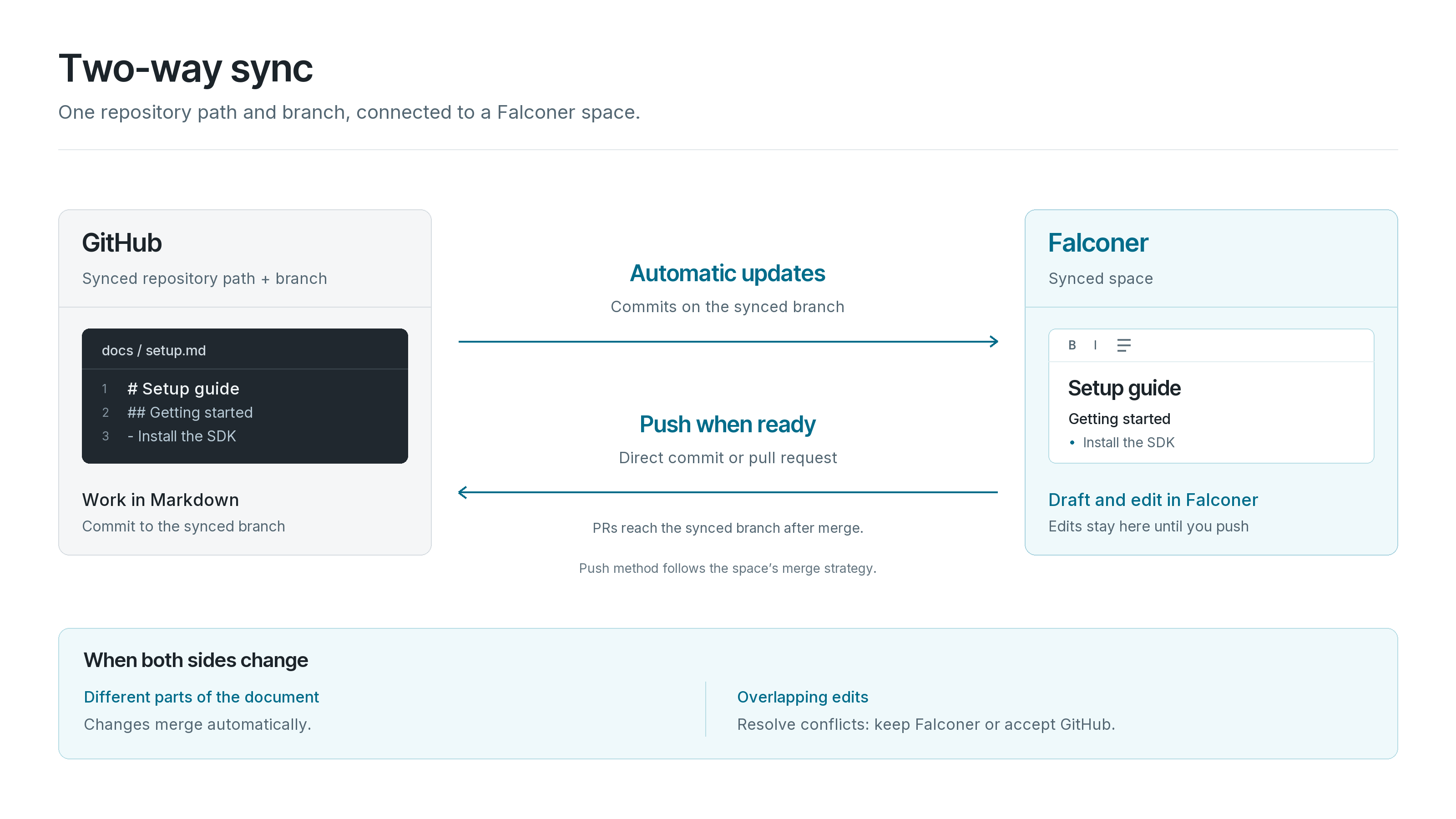
Bridging this gap means treating documentation as a single shared document rather than files passed back and forth. Instead of replacing an entire file, two-way sync updates only the specific sections of the doc that changed. Commits on GitHub land in the editor without disturbing open suggestions, and edits in the editor reach the repository using the team’s review rules.
How changes flow both ways
With Falconer’s Two-way sync feature, you connect a Falconer folder to a directory in a GitHub repository. Every document in the selected path maps directly to a Falconer document.
- GitHub to Falconer: Commits on the synced branch flow into the matching documents and branches automatically.
- Falconer to GitHub: Edits in Falconer are pushed back to the repo when you choose to push, using the workflow your team already uses.
1. Pushing on your team’s terms
Every team reviews docs differently, so the merge strategy is a per-space choice:
| Strategy | What happens on push | Good fit for |
|---|---|---|
| Direct commit | Commits straight to the configured branch | Fast-moving internal docs |
| Pull request | Opens or updates a GitHub pull request | Teams that review docs like code |
Repository rules keep applying. If your docs directory needs code-owner approval, a change written in Falconer still gets it.
2. No silent overwrites
Under normal conditions, background sync applies GitHub commits to Falconer documents automatically in real time. When edits collide on the exact same lines, that automatic flow pauses and the file receives a Conflicts status. Falconer prevents silent data loss by holding both versions in a side-by-side diff until someone reviews the differences, resolves the overlap, and pushes the clean result.
3. Nothing disappears without a decision
When a file is deleted on GitHub, Falconer never silently archives the document. Inbound deletions require explicit review, allowing you to either confirm the removal or restore the file and push it back to the repository.
4. Images and media stay attached
Assets referenced in synced Markdown sync in both directions. Push from Falconer and embedded images and media assets are committed with the doc. Commit an asset on GitHub and it renders in Falconer.
5. Preserving developer and writer ergonomics
Technical teams keep their preferred code editor, branch workflows, and pull request reviews. Cross-functional teams keep rich formatting, comments, live suggestions, and real-time collaboration. Throughout the entire process, your repository remains the single deployable source for building and hosting your documentation.
Your agents are gambling on which doc is true
Documentation drift is disruptive with AI agents in the workflow. Coding agents read repository files for architecture, APIs, and schemas, while enterprise assistants query internal knowledge bases to answer employee and customer questions. When repo Markdown and wikis diverge, agents pull contradictory context and confidently repeat outdated guidance.
Knowledge management has always been constrained by maintenance rather than storage. Two-way sync turns documentation maintenance into automated infrastructure. By keeping repository Markdown and collaborative documents aligned in real time, people and agents always operate from the same verified facts.
Give both teams one doc to trust
Try out two-way sync on your own, or let us walk through the setup with you.
Ready to get started?
Create an account and start building your knowledge base — no contracts or credit card required. Or, contact us to design a custom package for your team.